Most people think AI agents and chatbots are the same thing. They’re not. And that misunderstanding is costing businesses time, money, and growth.
The truth is simple: one just talks, the other actually works.
In this guide, you’ll learn the real AI Agent vs Chatbot Difference in plain language. No jargon. No confusion. Just clear answers so you can decide what you actually need.
This matters more than ever. Businesses are moving toward automation, and choosing the wrong tool can slow you down instead of helping you grow.
What Is a Chatbot?
A chatbot is a program that talks to users. It answers questions, gives information, and follows a script.
Think of it like a digital assistant that can only reply based on what it has been taught before.
Most chatbots don’t think. They respond.
They work using rules or simple AI models. When you ask a question, the chatbot matches it with a stored answer and sends a reply.
Types of Chatbots
There are two main types of chatbots.
Rule-based chatbots follow fixed paths. If you say something unexpected, they fail. They are simple but limited.
AI/NLP chatbots use natural language processing. They understand basic intent and give better responses, but they still don’t act on their own.
Real-Life Examples of Chatbots
You’ve already used chatbots many times.
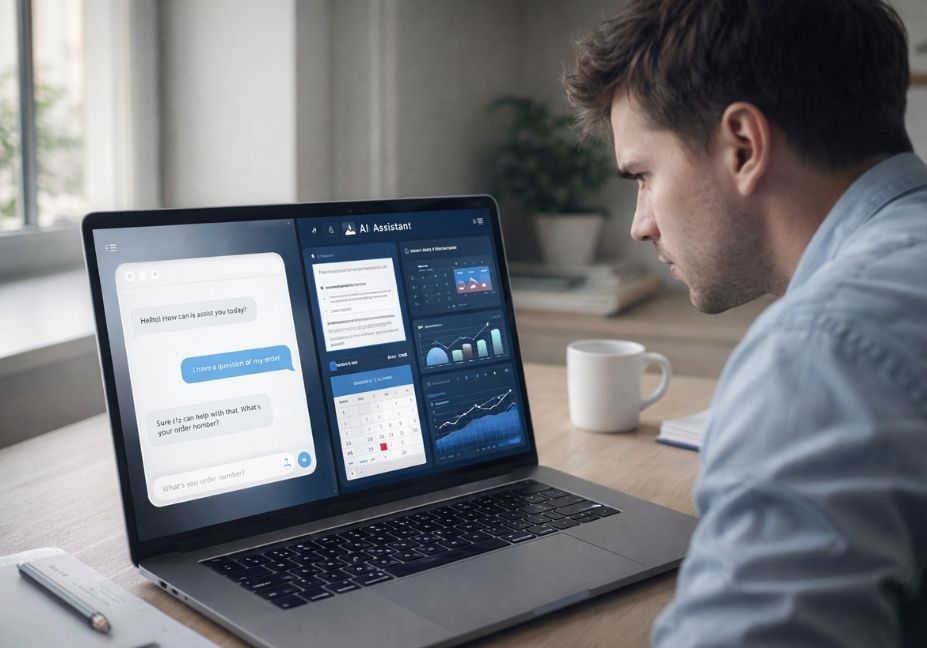
Customer support bots on websites answer common questions like “Where is my order?” Many platforms like Zendesk use chatbots to handle support queries quickly.
FAQ bots help users find quick information without talking to a human. These bots are designed to reduce wait time and improve user experience.
If you want to understand how chatbots work in real business environments, you can explore this guide by IBM on chatbots and their use cases.
These systems are useful, but they stop at conversation.
What Is an AI Agent? (Next-Level Automation Explained)
An AI agent is more than a chatbot. It doesn’t just talk—it thinks, decides, and acts.
This is where the real AI Agent vs Chatbot Difference begins.
An AI agent can understand a goal and take steps to complete it. It doesn’t wait for instructions every second.
Instead of just replying, it solves problems.
How AI Agents Work
AI agents use memory, tools, and reasoning.
They can remember past actions, use software tools, and make decisions step by step.
For example, instead of saying “I can’t help,” an AI agent can actually complete a task like booking, analyzing, or generating something.
Real-Life Examples of AI Agents
AI agents are already being used in powerful ways.
Task automation agents can manage emails, schedule meetings, and handle workflows.
AI assistants can research, write content, analyze data, and complete multi-step tasks without constant input.
This is not just conversation. This is execution.
AI Agent vs Chatbot Difference (Core Breakdown)
Let’s break the AI Agent vs Chatbot Difference in the clearest way possible.
A chatbot is reactive.
An AI agent is proactive.
A chatbot waits for you.
An AI agent works for you.
This difference changes how businesses operate.
Key Differences Table
| Feature | Chatbot | AI Agent |
|---|---|---|
| Intelligence | Basic understanding | Advanced reasoning |
| Decision Making | No real decisions | Makes decisions |
| Task Execution | Cannot act | Can complete tasks |
| Learning | Limited | Continuous improvement |
| Use Cases | Support, FAQs | Automation, workflows |
If you remember one thing, remember this:
Chatbot = answers
AI Agent = does
AI Agent vs Chatbot Difference in Real Use Cases
Understanding theory is not enough. Let’s see how the AI Agent vs Chatbot Difference works in real life.
Customer Support
A chatbot answers questions like “Where is my order?”
An AI agent can track the order, contact systems, update the user, and even fix the issue.
One replies. The other resolves.
Business Automation
A chatbot interacts with users but cannot perform actions.
An AI agent can automate tasks like sending emails, managing CRM systems, and updating records.
This saves real time and effort.
Marketing & Sales
A chatbot collects leads through forms or chats.
An AI agent can qualify leads, follow up, send emails, and even guide users through a sales funnel.
This is where businesses see real growth.
Why Most People Confuse AI Agents and Chatbots
The confusion is not your fault.
Both tools use chat interfaces. They look the same on the surface.
Marketing terms also make it worse. Companies label basic chatbots as “AI agents” to sound advanced.
Another reason is lack of understanding. Many people focus on the interface, not the capability.
The real AI Agent vs Chatbot Difference is not how they look—it’s what they can do.
Pros and Cons of Chatbots
Advantages
Chatbots are easy to build and quick to launch.
They are low-cost solutions for basic tasks.
They are perfect for handling repetitive questions.
Limitations
They have limited intelligence and cannot go beyond scripts.
They fail in complex situations.
They depend heavily on predefined responses.
Pros and Cons of AI Agents
Advantages
AI agents can act independently and complete tasks.
They make smarter decisions based on context.
They can scale automation across different systems.
Limitations
They are more complex to build and manage.
They require higher investment.
They need monitoring to ensure accuracy and control.
When Should You Use a Chatbot vs an AI Agent?
Choosing between the two depends on your goal.
Use Chatbot If
You need simple automation.
Your budget is limited.
Your tasks are repetitive and predictable.
Use AI Agent If
You want full automation.
You deal with complex workflows.
You need systems that can think and act.
Future of AI Agents vs Chatbots
The future is moving toward AI agents.
Businesses are shifting from simple conversations to full automation.
AI agents will handle more tasks, reduce human workload, and improve efficiency.
Chatbots will still exist, but mostly for basic use cases.
The gap in the AI Agent vs Chatbot Difference will continue to grow.
AI Agent vs Chatbot Difference — Final Verdict
Here’s the truth, without confusion.
Chatbots are useful, but limited.
AI agents are powerful, but more demanding.
If your goal is simple interaction, use a chatbot.
If your goal is real automation and growth, use an AI agent.
Final takeaway:
Chatbot = responds
AI Agent = acts
FAQs
What is the main AI Agent vs Chatbot Difference?
The main difference is that chatbots respond to questions, while AI agents can take actions and complete tasks automatically.
Are AI agents better than chatbots?
AI agents are more powerful, but not always necessary. Chatbots are better for simple tasks, while AI agents are best for complex automation.
Can a chatbot become an AI agent?
Yes, advanced chatbots can evolve into AI agents by adding memory, tools, and decision-making abilities.
Which is best for small businesses?
Small businesses should start with chatbots for cost and simplicity, then move to AI agents as their needs grow.